
Arabian horse breeding has a storied place in equine history, founded on the Arabian Peninsula’s legacy of producing horses with unique and highly sought-after characteristics. These horses are renowned for their distinctive head shape, large expressive eyes, and high tail carriage, making them one of the most identifiable breeds globally. The breed’s refined features stem from centuries of careful and selective breeding practices, initially developed by the Bedouins, who prized these horses for their strength, endurance, and beauty.
Selective breeding of Arabian horses has shaped the breed into one with a notable compact size and a reliably gentle temperament. These factors contribute to the Arabian horse’s popularity as a breeding animal. Beyond their physical attributes, Arabian horses have influenced many other breeds, enhancing traits like stamina and agility in the resulting lineages. In Europe and beyond, they have been instrumental in the development of other breeds, such as the Percheron in France and the Orloff Trotter in Russia.

Despite their storied success, Arabian horse breeding has not been without controversy. The pursuit of specific aesthetic traits has sometimes resulted in health issues, such as breathing difficulties, particularly when those traits become overly pronounced. This has sparked discussions within the equestrian community regarding the ethics and future direction of breeding these prestigious animals. Nevertheless, Arabian horses continue to be a symbol of equine beauty and heritage, captivating horse enthusiasts around the world.
Origin and History
The Arabian horse breed has a rich legacy that is deeply intertwined with historical figures and the Bedouin tribes of the Arabian Peninsula, shaping many cultures and impacting the bloodlines of various equine breeds.
Arabian Peninsula and Bedouin Tribes
Originating from the Arabian Peninsula, the Arabian horse is one of the oldest breeds, known for its endurance, spirit, and distinct physical features. These horses were first domesticated and selectively bred by the Bedouin tribes, who valued them not only for their attributes in warfare and trade but also for their status within the tribe. A characteristic unique to the Arabian is its skeletal structure, often having one less vertebrae and rib than other breeds.
Historical Figures
Historical figures have played significant roles in the proliferation and prestige of Arabian horses. Prophet Mohammed emphasized the importance of the Arabian horse in Islamic culture, advocating for the care, breeding, and treatment of the Arabians. Genghis Khan utilised their superior stamina in his campaigns, while Napoleon Bonaparte selected Arabian horses for their courage and resilience. Across the Atlantic, George Washington, known for his affinity for exceptional horse breeds, also incorporated Arabians, further cementing their global influence.
Characteristics of Arabian Horses
The Arabian horse stands out with its distinct head shape, observable high tail carriage, and a variety of coat colours denoting its unique genetic makeup. These features, coupled with a spirited gait, epitomise the breed’s noble and recognisable presence.

Unique Head Shape and Profile
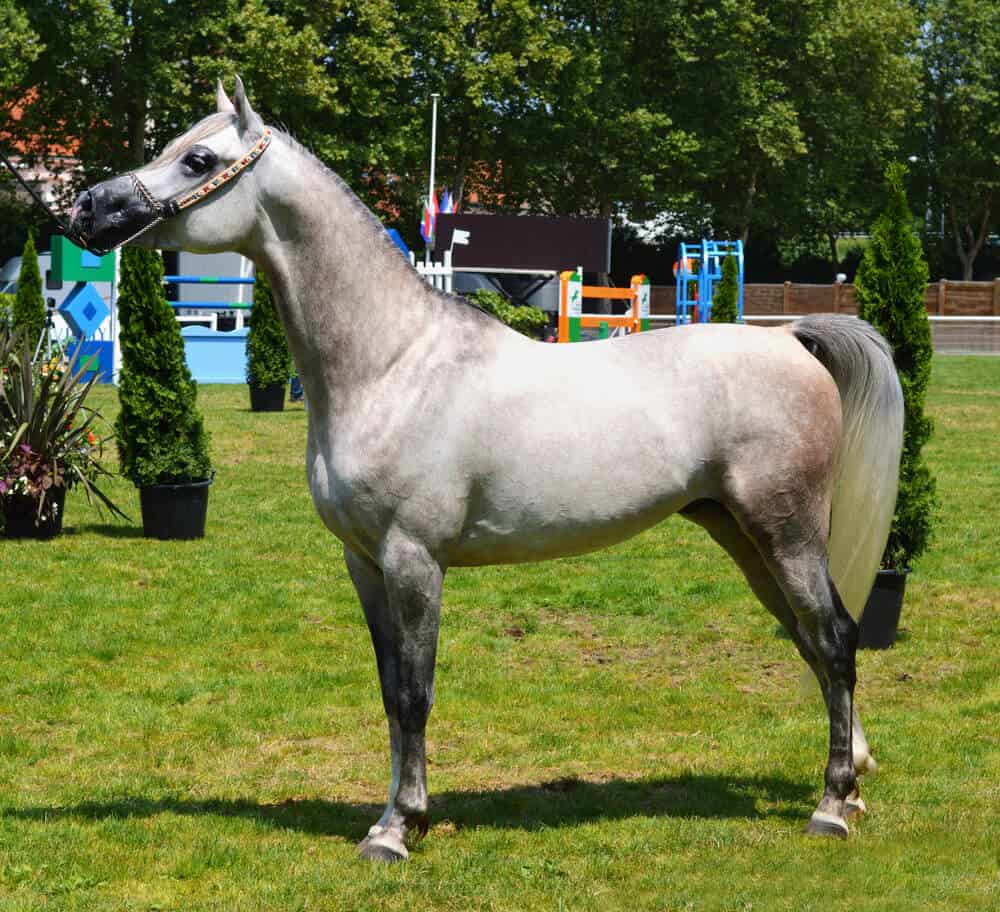
The Arabian horse boasts a unique head shape characterised by a concave profile. One can easily spot the dished face, often framed by an abundance of mane. The breed also features prominent eyes that contribute to a keen and intelligent expression.
High Tail Carriage and Movement
High tail carriage is a hallmark of the Arabian horse, with the tail held aloft when the horse is in motion, indicating liveliness and grace. This characteristic complements their overall agile and spirited movement.
- Movements:
- Animated gait
- Graceful strides
Coat Colours and Markings
Arabian horses present with a spectrum of coat colours, predominantly bay, grey, chestnut, and black. White markings on the face and legs are common, yet the horses possess black skin underneath, which historically provided protection against harsh sunlight.
- Coat Patterns:
- Solid
- Piebald or Skewbald (less common)
Arabian horses often have short cannons, contributing to their strength and endurance, and may have one fewer lumbar vertebrae, resulting in a shorter back. These distinctive physical traits enhance both the appearance and the athletic capabilities of Arabian horses.
Breeding Practices
Breeding Arabian horses is a meticulous process that centres on preserving the purity of bloodlines and ensuring the health of future generations. These practices are critical to maintaining the breed’s integrity and heritage.

Lineages and Arabian Bloodlines
Arabian horses are well-known for their distinct and prestigious bloodlines. Historically, breeders have placed significant emphasis on tracing pedigrees through several well-established strains or families. These include, but are not limited to, the Al Khamsa, hadban, kuhaylah, saklawi, and ma’naqi. These strains represent the core genetic pools from which modern Arabians descend.
Documenting pedigrees is an integral part of the breeding process as it helps breeders to make informed decisions. They meticulously select pairs that are most likely to produce foals exemplifying the breed’s desirable traits, such as endurance, intelligence, and a gentle temperament.
Health and Genetic Disorders
When breeding Arabian horses, attention to genetic health is paramount. Breeders must be aware of hereditary conditions that can affect Arabians. Some known genetic disorders in this breed include:
- Severe Combined Immunodeficiency (SCID): An autosomal recessive disorder that leaves foals with no immune protection.
- Cerebellar Abiotrophy (CA): A neurological condition leading to incoordination and head tremors.
- Lavender Foal Syndrome (LFS): A neurological syndrome that can cause seizures and is often fatal.
To combat these issues, breeders use DNA testing and other genetic screening tools to detect carriers and make responsible breeding choices to minimise the risk of passing on such conditions. This careful screening is vital for producing healthy Arabian foals and for the welfare of the breed as a whole.
Strains of Arabian Horses
Arabian horses are known for their distinct strains, which can be traced back to the breed’s origins in the Arabian Peninsula. These strains are often associated with particular tribes or families who bred them. For example, the Saqlawi strain was bred by the Jidran family, resulting in the Saqlawi Jidran. Other basic strains include the Muniqi, Saglawi, Abayyan, and Kuhailan, with all descending from the Kuhaylan, which signifies “purebred”.
In addition to these traditional strains, several types of Arabian breeds have developed due to breeding practices around the world. These include the Egyptian Arabian, Russian Arabian, Polish Arabian, Crabbet Arabian, Spanish Arabian, and Shagya Arabian. Each type has its unique characteristics and has contributed to the diversity within the breed.
Arabian Horses in Equestrianism
Arabian horses continue to excel in modern equestrianism, showcasing their versatility both in competitive arenas and as a breed that has influenced global equine breeds.
Modern Role of the Breed
Arabian horses are considered a modern breed of riding horse, valued for their intelligence, agility, and stamina. They are integrated into various equestrian pursuits from endurance riding to show jumping. Arabian stallions and mares contribute significantly to the genetic pools of numerous breeds, enhancing traits like appearance, endurance, and temperament. Their enduring legacy is observed in the fact that they are often crossbred to develop new breeds or to improve existing ones.
Competitions and Championships
In the world of equestrian sports, Arabian horses are especially known for their participation in specific disciplines tailored to highlight their strengths:
- Performance:
- Dressage
- Show Jumping
- Endurance:
- Long-distance competitions
- Shows:
- Arabian Halter/Breeding classes
- Arabian Performance Halter
These competitions demonstrate the breed’s adaptability and finesse. At the world championship level, Arabian horses compete globally, where the finest examples of the breed are showcased and their conformation, movement, and suitability for various roles are meticulously judged. Events such as the National Championship of Libyan Arabian Horses bring equestrians together, celebrating the Arabian horse’s significance in equestrian sports.
Arabian Horse Registries and Associations
The Arabian Horse Association (AHA) stands as an authoritative entity within the United States and Canada, overseeing the Arabian horse breed. It possesses a substantial membership base of 15,000, linking a myriad of Arabian, Half-Arabian, and Anglo-Arabian horse owners. This association offers extensive services, including keeping track of lineage, breeding, and competitive records.
Key Functions of AHA:
- Registry Maintenance: More than 1 million horses have been in the AHA registry since its inception in 1908.
- Member Services: Providing resources for those engaged in breeding and competitive activities.
Historically, the AHA was known as the Arabian Horse Registry of America. This body was paramount in maintaining the purity of the breed and the organisation of member services, such as managing breeding records and offering insights for breeding plans.
A significant part of the heritage of Arabian horses can be attributed to the Crabbet Arabian, cultivated in England. Many modern-day Arabian horses trace their lineage back to these pedigrees, denoting the global impact of Crabbet breeding on the Arabian horse breed.
Key Registries and Associations for Arabian Horses:
| Organisation | Focus |
|---|---|
| Arabian Horse Association (AHA) | Registry, Member Services, and Horse Shows |
| Arabian Horse Registry of America | Record Keeping and Pedigree Tracking |
| Crabbet Arabian | Historical Lineage and Breeding Practices |
These associations facilitate connectivity among enthusiasts, promote the preservation of the breed, and offer platforms for competition and recreational engagement with Arabian horses, reflecting the enduring allure and respect commanded by these equine athletes.
Cultural and Regional Impact
Arabian horse breeding has significantly shaped equestrian practices, with pronounced effects in the Middle East and extending to Northern America.
Influence in the Middle East
In regions such as Saudi Arabia, Arabian horses are deeply woven into the cultural fabric. Principally, these horses have been bred for their stamina, intelligence, and loyalty, critical traits that have historically benefited the Bedouin tribes of the Arabian Peninsula. Not merely for transport, Arabian horses also played an essential role as a status symbol among tribes, augmenting societal structures.
- Saudi Arabia: Heartland for Arabian horse breeding; their significance is evident through historical and cultural narratives.
- Middle East: Broader regional influence where Arabian horses have facilitated cultural exchanges and influenced socio-economic landscapes.
Expansion to North America
The introduction of Arabian horses in the United States marked an extension of their cultural impact beyond their native lands. They arrived in North America in the 18th century, influencing breeds such as the Thoroughbred, which possesses a lineage connected to the Arabians.
- United States: Adopted Arabian horse breeding to improve local breeds and start new lineages.
- North America: The region where Arabian horses contributed not just genetically but also to equestrian sports and cultural practices, underscoring their multifaceted influence within the sphere of horse breeding.
Arabian Horse Care and Management
Arabian horses are renowned for their endurance and ability to traverse long distances, making their care and management slightly different from other breeds. They thrive on a forage-based diet, though various nutritional requirements must be met to maintain their health and stamina.

Diet and Nutrition
- Forage: Should consist primarily of high-quality hay, enforcing a forage-only diet to aid in digestion and provide necessary fibre.
- Grains: May be added to the diet in moderation to meet energy demands, especially for active horses.
- Supplements: A balance of vitamins and minerals should be considered to complement the forage-based diet.
Exercise and Training
To accommodate their innate stamina and spirit, regular exercise is vital. It helps in maintaining their physical condition, particularly for those bred for competitive sports or covering prolonged distances.
Health Care
Regular veterinary check-ups ensure vaccinations are up to date and any health concerns are addressed promptly. Attention should be given to dental care, hoof maintenance, and parasitic control.
Grooming
Grooming not only strengthens the bond between the horse and its handler but also allows for close observation of the horse’s condition. A routine should include brushing, hoof picking, and coat care to promote overall well-being.
Proper care and management can lead Arabian horses to live well into their thirties, showcasing their resilience and longevity. A well-implemented care program forms the cornerstone of their vitality and performance across disciplines.
I hope you have found this post useful. Do you have an Arab horse?
Let me know in the comments!
Frequently Asked Questions
When engaging in Arabian horse breeding, it is essential to understand the intricacies that surround their characteristics, uses, and breed standards to ensure the integrity of the breed.
What are the primary characteristics to look for in breeding Arabian horses?
Breeders should look for key characteristics such as a refined head, arched neck, well-sloped shoulders, and a strong back. The horse’s overall conformation, stamina, and purity of bloodlines are also crucial.
What are the common uses for Arabian horses that influence breeding decisions?
The beautiful Arabian horses are bred for various disciplines such as endurance riding, dressage, and showing. Their versatility also makes them suitable for recreational riding and competitive equestrian sports.
What advantages and disadvantages should one consider before starting to breed Arabian horses?
One should consider advantages such as the breed’s high demand and its prestigious heritage. However, potential breeders must also be mindful of the financial investment, the need for expert knowledge, and the time commitment required.
How does one determine if an Arabian horse meets the breed standard?
An Arabian horse can be assessed by evaluating its conformity to the breed’s characteristics as outlined by Arabian horse associations and societies, including head shape, tail carriage, and overall balance and symmetry.
To what extent is intelligence factored into the breeding of Arabian horses?
Intelligence is highly regarded in Arabian breeding as it affects trainability, temperament, and the ability to form bonds with humans, which are valued traits in the breed.
What considerations must be taken into account regarding the weight and height standards for Arabian horses?
Breeders should aim for horses that typically stand between 14.1 and 15.1 hands in height, bearing a weight that is proportionate to their size. This aligns with the breed’s standards for elegant but sturdy conformation.
You May Also Like:
- Crowning Glory: Exploring the World of Royal Horse Names
- Polish Horse Names: Embracing the Spirit of Poland in Every Whinny